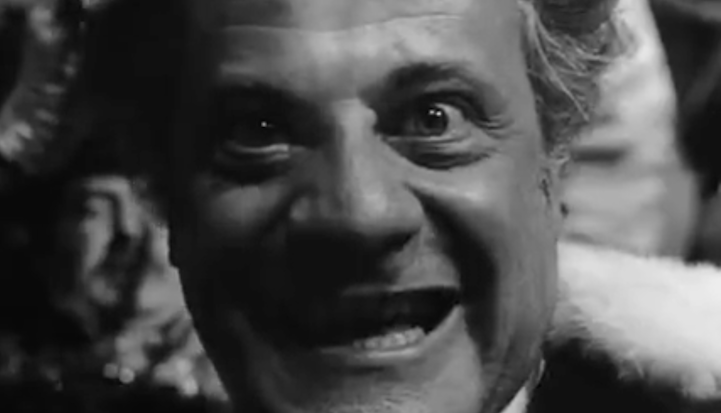
Director: Glauber Rocha
Year: 1967
Judge a man by his friends, they say.
That presents quite the dilemma in Glauber Rocha’s third feature, a raging and frenzied assault on the corruption seemingly inherent in politics, delivered (and initially banned) in the early years of Brazil’s 21-year military dictatorship.
I came to Entranced Earth, my first experience of the giant of Cinema Novo, with my curiosity piqued by two wildly contrasting opinions. Two Brazilian friends, both committed cinephiles – one insistent that I must experience Rocha, another profoundly turned off by what they saw as his pseudo-intellectualism and even alienation of audiences. But we must experience these things for ourselves.
Paulo Martins – a thundering Jardel Filho – is a journalist who seems to spend far more time on poetry, his lyricism forming much of Terra’s narration. He recalls in back-and-forth flashbacks how he came unstuck in attempted service of his country, the allegorical Eldorado, recalling a frenetic campaign trying to influence and force the hands of two opposing politicians toward something resembling social justice. His targets are a weak and corrupt populist, Felipe Vieira (José Lewgoy) and the raving fascist Porfírio Diaz (Paulo Autran) – named with firm intention after the devious, technocratic dictator of early 20th century Mexico.
Uncomfortably, both candidates were once friends to Paulo, which makes his own supposedly anarchist politics hard to trust (particularly when he responds to one desperate and disenfranchised citizen with bullying contempt). In his bouts of disillusionment, he also ricochets between activist girlfriend Sara (Glauce Rocha) and Diaz’s mistress Sílvia (a very silent Danuza Leão).
Rocha paints a vivid tableau. The uncritical spectacle of mass political fever; the rabid dogs of ambition, corporate influence and corruption; the wild 60s hedonism enjoyed by Diaz (and indeed Paulo, recalled among the memories of his scheming and despair); all are thrust before us with shuddering, inky camera work. The grandness of the settings – the Municipal Theatre of Rio de Janeiro and the mansion and lush, verdant botanical gardens of Parque Lage – only emphasise the ignominious doings of the characters within them.
That Rocha’s protagonist is so flawed himself feels core to this polemic. Likeable he is not, but if he were, Terra em Transe might play more like a tragic melodrama of thwarted best intentions than the searing indictment of Latin American politics that Rocha conjured. He documents a somewhat ancient Roman reality where the people are not deserving of care or hope for themselves, but are simply there to service and elevate political ambitions. Rather than relatable frontman, Paulo and the other characters stand as allegory for what Brazil’s people were subjected to under the oppression and upside down morality of the dictatorship.
Between Paulo’s unrelenting monologues, which rage at his own ever-shifting pain while firing blame in all directions, and 28 year old Rocha’s furious approach to filmmaking – stark, high-contrast and restless footage occasionally stilled in arresting snapshots, and interrogative sound design that leaves you feeling attacked by the film’s end, Terra em Transe is far from an easy watch. Rocha clearly didn’t feel like an allegory for the violent misery of new dictatorship should be a comforting experience. Instead it is demanding, memorable, and leaves you puzzling over it long afterward.