Director: Kleber Mendonça Filho
Year: 2025
It’s November 2025, it’s writer-director Kleber Mendonça Filho’s birthday, and former Brazilian president and Trump bestie Jair Bolsonaro has just been apprehended by the police and carted off to prison, after attempting to burn off his ankle tag and escape his 27-year sentence for orchestrating an attempted far-right coup. In the history of Brazilian political strife, the moment seems to offer a rare happy ending. Brazilian cinema over the last 60 years has attested to that trauma, starting in the 1960s with the likes of Glauber Rocha’s tortured responses to the new dictatorship, and leading up to Walter Salles’ Oscar-winning I’m Still Here last year.
Mendonça Filho’s 2025 political thriller, The Secret Agent, continues that legacy with an impish, beguiling exploration of the cancerous reach of the 21-year dictatorship, illustrating how totally the regime could distort and disfigure ordinary morality without even mentioning it.
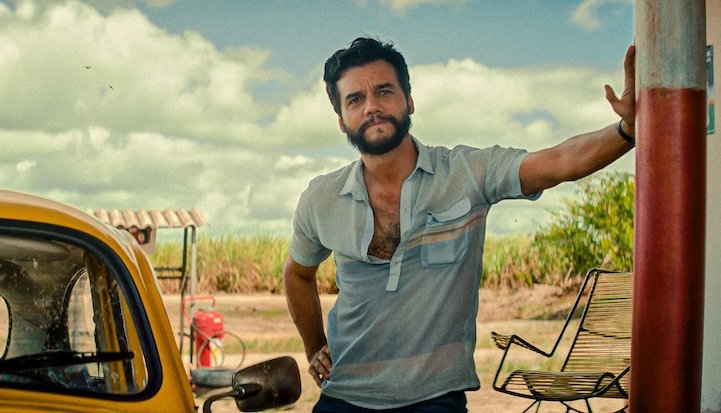
In a lead role written for him, Wagner Moura’s Marcelo goes into hiding in carnival-season Recife in 1977. The university professor has a young son to reconnect with, a mysterious past and a pair of hitmen on his heels. He subtly unveils a vicious reality while participating in the masquerade – an eyebrow here, a ghost smile there as he maps out his friends and enemies, an affable and quietly amused surface glossing over years of fury, anguish and grief. In his corner he has what remains of his family, some fellow political refugees housed by anarchic septuagenarian Dona Sebastiana (Tânia Maria), and a handful of activists intent on saving his life. The enemies are harder to discern. In a country under dictatorship for the last 13 years, money greases palms, undesirables disappear, and death is easy to arrange.
The uncertainty is heightened by Mendonça Filho’s entwining of carnival mania and urban mythology, both of which provide cover for state-sponsored violence and corruption. This is the comforting sanctuary that Marcelo finds himself in, and Moura cultivates an easygoing stoicism at odds with the threat and chaos around him. One panicked, prolonged reaction to the literal nightmare that Mendonça Filho has carefully brewed for him over the first two hours is one of the few times the mask slips.
It says much about Moura’s charisma and relationship with the camera that he can embody the calm at the eye of the storm, offering a contained but compelling performance while his character so passively navigates the injustice and dread stalking him. Moura has described himself as a very physical actor, and yet what he brings here, in his first Brazilian role in 12 years, is restraint, treading as softly as Louis Theroux through the strangeness around him. He plays Marcelo as someone who, despite his capabilities, things happen to, rather than someone who imprints his will on the world. In this political climate, having come unstuck through defiance, his personal act of resistance is now quiet resilience, absorbing his misfortunes without being changed or cheapened by them. It’s a subtle and deeply moving performance from an actor in experienced command of his craft, much more so than if Marcelo were to thrash and rail against the injustices in his orbit.
As our fugitive is out of tune with the vicious mood of the time, so is he out of step with the city’s feverish pace, moving on his own terms – and, with peril looming, all too slowly for our comfort – as he susses out his situation. This makes him something of a cipher for Kleber’s pacing. As with all of his work, The Secret Agent doesn’t race along with the hounds of hell on its back, drawing you to a linear denouement; it takes the back streets, with devious little detours into other people’s lives.
Don’t mistake its languid pace for aimlessness; here is tight decision-making. Mendonça Filho’s taste is for the unspoken, the unseen, and the strategic details that say as much as they conceal. Like a screw tightening slowly, the dread and tension are more agonising for their slow arrival under Recife’s hazy, scorched skies, and like a claw gloved in velvet, they sidle in arm-in-arm with humour, tenderness and mythic weirdness (itself emblematic of the surreal nightmare that engulfs reality when the rules no longer apply). The awful thing about political terror, like any real tribulation we might ever go through, is that its very awfulness isn’t enough to make it stop. Life goes on between the cracks; attraction draws lovers together, work carries on, people go and see movies even as the noose tightens around their freedoms and their very lives. Mendonça Filho understands that details which don’t feed the main story nevertheless illustrate his characters’ idiosyncrasies and peccadilloes, or are simply part of the fabric of the world he’s building, and make its texture all the more believable.
That’s reflected in KMF’s casting. The late, peerless Udo Kier plays a more haunting role – his last – than his sociopathic turn in Mendonça Filho’s Bacurau. His seemingly incidental part as a scarred Jewish tailor actually reveals a great deal about one of the film’s more sinister characters, the eagerly fascist police chief Euclides (an oily Robério Diógenes). Bacurau also introduced the irrepressible Tânia Maria, with a couple of lines in her debut acting role after a lifelong career as a ceramicist; in the pivotal part Mendonça Filho wrote for her in the Secret Agent, she’s a scene-stealing, chain-smoking mother hen with a mysterious, anarchist past, a breakout role that has already made her a cult star back home.
The Secret Agent feels like a culmination of the last fifteen years of Mendonça Filho’s work. His short and long studies of his home town, Recife (from the 25-minute mockumentary, Recife Frio, to the acclaimed Neighbouring Sounds which charted weird and unsettling undercurrents of life in the comfortable Boa Viagem neighbourhood) find final form in this rich, period portrayal of the city. His exploration of a roundabout way of telling stories, with side-quest details adding rich context, is one of the film’s defining features.
His deep love of cinema is also highly evident. The former film critic still curates a festival at the Cinema São Luiz, almost a character in its own right in The Secret Agent, and he knits the cinematic happenings of the time – the public mania around The Exorcist, and the wild success of Jaws – into the mythological fabric of his own story. His preceding documentary, Pictures of Ghosts, which charted the lost movie palaces of downtown Recife, was essentially a primer for this film (if Pictures of Ghosts was Mendonça Filho’s My Life in the Bush of Ghosts, then The Secret Agent is his Remain in Light).
And although Mendonça Filho broke from his longtime partnership with cinematographer Pedro Sotoro (Pictures of Ghosts, Bacurau, Aquarius, Neighbouring Sounds), instead working with Evgenia Alexandrova, there’s a clear and very distinctive visual through line. In all of his films you’ll see an intense, tropical colour palette, which Alexandrova delivers to exquisite effect. The editing skips the clichéd, “it’s hot, make everything yellow and dusty” colour grading that’s so prevalent in cinema. Instead it’s a bright, sunlit symphony of vivid colour that, along with perfect attention to detail in the costuming, brings the 1970s setting alive without feeling like pastiche. Its inviting juiciness makes the violence of the era even more stark in its cruelty and horror (bringing to mind a smidge of Kubrick and the playful colour palette he employed in The Shining).
As much as The Secret Agent is a searing portrayal of one of Brazil’s darkest periods, its portrait of the violence of corruption rings true beyond its historical context, and says something urgent to us about the world we live in today. Marcelo resists state-sponsored corporate corruption, and his persecutor (played with amphibian twitchiness by Luciano Chirolli) does not regard him simply as an annoyance or an obstacle to be cleared. His hatred is so concrete it has a shape; it’s the hole he wants to see blown in his victim’s face. This isn’t about cold hard victory; he truly believes Marcelo deserves this. Morality is through the looking glass: everyone is now expected to be compliantly corrupt, and Marcelo refuses. How dare he exempt himself from the new rules, and in the face of his enemy’s fast-moving corruption, how dare he be a mirror when he ought to be a door? His transgression is so counter to the direction of travel, it demands death and permanent erasure from history.
This is the violence The Secret Agent explores; not just the harm itself but the rewriting of the rules and the way that society was co-opted en masse, if not into direct violence and betrayal, then into silence and forgetting. Every aspect of the film probes the tension between memory and forgetting – those who forget for their own survival, and those who erase memory to preserve power and inflict terror. It’s in the story itself, and what it leaves out, its unanswered questions; it’s also in the scars and photos its characters carry, and the false stories and memories planted by the foot-soldiers of the regime.
For countries facing creeping (or rushing) fascism and authoritarianism, the lessons about what it will do to everyone are clear – and for the Brazilians, who pushed back against its resurgence at home, The Secret Agent highlights the momentousness of their success. But it goes further.
What Marcelo fundamentally resists is a dark, sociopathic absurdity, one that surrounds us today wherever we live. That absurdity is at work in governments prosecuting people for protesting against genocide, and applying devastating, worldwide personal sanctions to UN representatives and judges for doing their jobs and trying to prosecute crimes against humanity. It’s in the ICE agents threatening to deport Native Americans from their own homeland, and the tech companies colluding with news media to tell people that “device hoarding” (a novel and spectacular term for not buying a new iPhone if you don’t need one) is destroying the economy, as a counter to rising public awareness of the horrific human and ecological cost of mineral mining. Meanwhile, the absurdity of Brazil’s political story continues, and its fascists still seek rehabilitation – it was recently announced that Jim Caviezel will play Bolsonaro in a “heroic” biopic written by Mário Frias, the disgraced president’s former Secretary of Culture.
To resist the violent and the corrupt, even by the most passive means, is increasingly to be cast as an enemy of society, a theme that seems dear to Moura in particular, who also recently co-authored and starred in a stage riposte to Henrik Ibsen’s An Enemy of the People, which addresses the same absurdity. Indeed, both he and Mendonça Filho suffered their own personal consequences during Bolsonaro’s reign of vengeful stupidity, seeing their projects blocked from release and dealing with online attacks meant to discredit them to this day, a formative experience that ultimately birthed their partnership on this film.
Dictatorships come and go, but the weaponisation of that upside-down morality is an ongoing human failing, and provides rich pickings for writers with the skill to trace the pathways between historical periods and our present-day failings, and the ways in which we are all expected to participate in state violence and uphold corrupt systems, or pay the price. The Secret Agent offers a masterful perspective on this, and deftly offsets the thematic darkness with nimble, intoxicating filmmaking that leaves us moved, giddy and deeply unsettled.
The Secret Agent is stylish, tense, sophisticated and a sensory delight, and sees Mendonça Filho and Moura doing some of the finest work of their careers – a virtuoso partnership that must surely continue. Brazilian cinema is on a tear right now, and if you’re new here, you couldn’t ask for a more beguiling introduction than this. It already nabbed an audacious handful of Cannes silverware and has rightly started to amass prizes and nominations, on a ride that deserves to take it all the way to the Oscars.