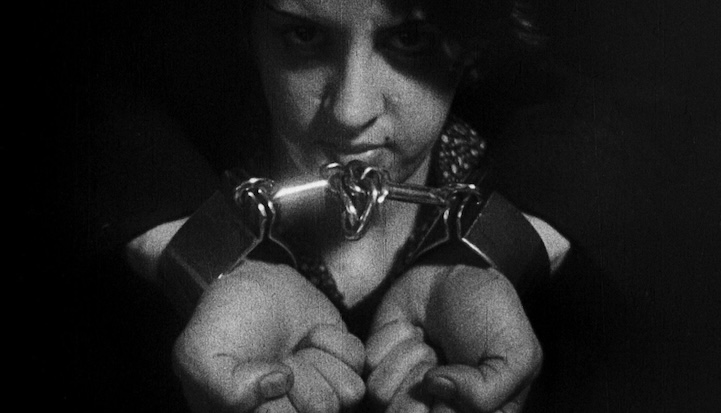
Director: Mário Peixoto
Year: 1931
Some films have big shoes to fill on account of a director or actor’s previous work, or some other precedent that they have to. Limite has to live up to its own legacy. Mário Peixoto‘s masterpiece became the stuff of IYKYK cult legend early on, and, for 21st century viewers, it sets expectations vertiginously high for this most experimental of films. Yet as challenging as it is, its influence is far-reaching, and you can see its hallmarks even in cinema today.
While the great and good were gathering on a Sunday afternoon in February for the BAFTAs, across the river the ICA screened Limite to accompany Brazilian artist Laura Lima’s ongoing exhibition The Drawing Drawing. The facts surrounding this revered film are these: first screened in 1931, the silent film would prove to be director Mario Peixoto’s sole feature film, and he guarded it jealously, refusing commercial screenings (Orson Welles did get to have a look, though). Following improper storage, by 1959 it was presumed damaged beyond repair, yet still confiscated by the police in the ‘60s during Brazil’s military dictatorship. Yet rumours of its death were greatly exaggerated – it was retrieved and painstakingly restored in the 70s, though it lives as the walking wounded, with one scene missing.
Cinemateca Brasileira – which helped restore it – called it the greatest Brazilian film of all time, and the film is prized by UNESCO. It was restored again in 2002, and nearly ten years ago the Criterion Collection added Limite to its repertoire, finally making it accessible to ordinary viewers. Oh, and Martin Scorsese is a fan, including it in his World Cinema Project restoration/preservation mission. No big deal.
With a backstory like that, you could make a compelling and even accessible film about the film, its auteur and its advocates. Maybe Richard Linklater would like to take up the challenge. The film itself is a different proposition altogether. It was experimental for its time, and nearly a century later, when so much has changed about the way we watch cinema, it requires one to reset one’s expectations, slow down and prepare to be led by a hypnotic experience.
Peixoto created Limite when he was just 21. Inspired by an arresting André Kertész photo, it’s a deeply meditative, solipsistic study of three people who’d rather die at sea than continue on land: one woman fleeing an alcoholic husband and unhappy marriage, another escaping the long arm of the law, and a man dealing with the dark aftermath of an extramarital affair. Limite opens on the water, in the flimsy rowboat that these three now call home, and takes us through each traveller’s troubled past.
The pace is slow and lingering, and without dialogue, you have to deduce a lot from movement and gesture. That’s made harder because Peixoto liked to spend a long time contemplatively on one or another scene, creating a dreamlike world where it’s hard to tell what’s real, what’s past and present. To complicate things further, we get occasional title cards with printed dialogue, but at the screening I went to, there were no English subtitles for these, leaving non-Portuguese speakers somewhat stranded far offshore from these little islands of understanding.
One suspects Doutor Peixoto might have approved of this, mind. Limite feels like a film he needed to make for himself – an exorcism of ideas – rather than one he desperately wanted others to see or understand. The landscape photography, soundtracked by an melée of composers from different epochs, is forceful, painterly and exquisite, if understandably grainy, and the studies of human emotion are haunting. It’s clear he revelled in exploring technique and creating beautiful, memorable imagery, but he wasn’t interested in editing his vision down to something digestible for audiences who didn’t get to see it anyway. At one point, the boat is rocked by a violent storm, communicated simply by several minutes of furiously rushing water in close-up, washing back and forth, some of the footage seemingly recycled during the sequence. One suspects it mattered more to him that the lucky few who viewed it should feel the experience, sense themselves buffeted by the cold water and mesmerised by its motion, rather than be compelled forward by narrative.
Peixoto wrote extensively about his own film in the decades after its initial release, and started other projects, but never finished anything. Was he held hostage by his first great labour? Did he feel he couldn’t measure up to the ambitious vision of Limite? While his subsequent screenplays went unrealised, Peixoto published poetry, short stories and a play instead, as well a single novel. Walter Salles gathered a number of these materials in the Mário Peixoto Archive, offering some insight into this most mysterious man.
For such a secretive film, Limite has ended up becoming revered, studied by film students and masters of their craft, and upheld as one of Brazilian cinema’s formative achievements. Even in today’s cinema you can see traces of Peixoto’s ideas, conscious or otherwise – most recently perhaps in Galician writer-director Oliver Laxe’s Sirāt, in which a band of travellers seek their own increasingly disturbing oblivion from the world, while confronting their own smallness and mortality within violently beautiful landscapes. Unsurprisingly, his influence also crept into Salles’ work, most notably in his 2002 film Abril Despadaçado (Behind The Sun), who took thematic and photographic cues from Limite and even borrowed Peixoto’s middle name for his main characters.
And so to today. We all film everything, everywhere, all the time, we consume media half-attentively at breakneck pace (indeed, sped up to 1.5x lest people drift off), and depressingly, studios are making content for people to watch with their phone in their hand and their eyes elsewhere. Where does Limite fit into this, uncompromising in its pace, cinematography and storytelling? Yet the ICA screening was full, and people either side of me were taking notes. Even for students of cinema, it’s not a facile experience, but if you’re looking to trace the roots and reach of Brazilian cinema further back than Cinema Novo, Limite must be on your path.