Director: Héctor Babenco
Year: 1985
Last night Brazil’s stellar Oscars campaign ended short of a trophy, albeit with 99 other awards gathered by its contenders across the season. It feels apt, then – and oddly comforting – to watch Brazilian director Héctor Babenco‘s 1985 drama, which made history as the Oscars’ first independently produced nominee. Just like this year’s snubbed entry The Secret Agent, Kiss of the Spider Woman also took the Best Actor gong at Cannes before racking up four Academy nominations. On that occasion, however, American lead William Hurt would scoop the Best Actor Oscar. (It’s also rather a departure for us to cover it, as an English-language film, but its production credits and its parallels with this weekend’s events make it too tantalising not to write about.)
Babenco’s thoughtful film drifts between genres: romance, queer cinema, fantasy, psychological drama, political thriller, the direction of the narrative thread in each genre steered by each other. In Kiss of the Spider Woman, the tenderness of unlikely love snakes around the brutality of persecution under dictatorship.
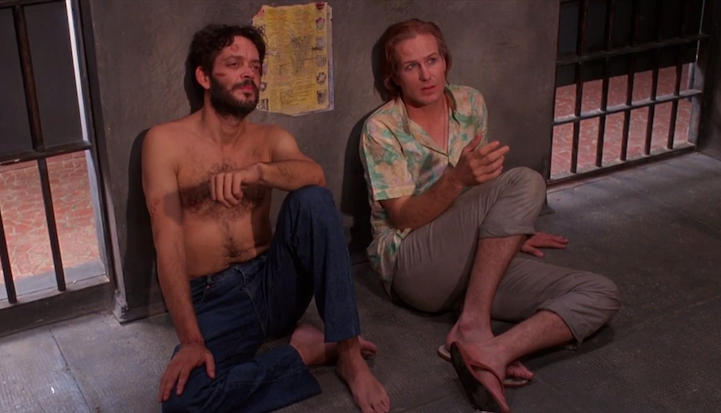
Valentin is a brusque political prisoner, played by Puerto Rican actor Raul Julia – best known to many as Gomez Addams. Jailed and tortured for helping the leftist resistance, Valentin and his daydreaming trans cellmate Luis/Luisa (the character uses both names but largely female pronouns) form a complex bond as they navigate a tightrope between escapism and betrayal. Luis, played with restrained sensitivity by Hurt, is apolitical, perplexed by Valentin’s ascetic nature and fervent political convictions. She insulates herself from the squalid tedium of the prison cell by retelling her favourite old movies. Valentin despises Luis’s escapist tendencies and her unprincipled attraction to bourgeois pleasures, but lets Luis talk the nights away, and so begins a relationship that challenges their perceptions of each other and themselves, changing the course of their lives. Unbeknown to Valentin, however, Luis isn’t quite what she seems.
At the time of writing, I’ve seen two other Babenco films: Pixote and Carandiru, both of which harrowingly confront the brutal realities of life for those dealt a bad hand and locked up for it. Kiss of the Spider Woman, developed from the novel by Argentine writer Manuel Puig, isn’t happy stuff, but it has a warmer touch, suffused with hope amid the pain. The dictatorship’s cruelties and privations are glimpsed but not lingered on, and in a film-within-a-film, we also get scenes from Luis’s favourite movie, a highly questionable Nazi propagandist melodrama in parallel with Luis’ own moral dilemma. Valentin is disgusted by his cellmate’s taste in cinema; Luis dismisses the film’s politics, imprinting her romantic loneliness and escapism onto its tragic love story instead. Hurt’s gentle performance avoids clichéd campy stereotypes, presenting Luis’s queerness as an inherent part of her selfhood, and centring her emotional yearning in a universally human way.
And so we get an unusual interplay between the full-colour present day prison reality, and the kitschy, hammily acted, almost-sepia 40s film romance. Enter Brazilian cinematic legend Sonia Braga playing three roles as the fictitious filmic heroine, the dreamed up Spider Woman of Luis’s imagination, and Valentin’s long-lost paramour. (A Cannes Best Actor award, a Brazilian actor playing multiple roles AND Oscars contention? Uncanny…) Luis’ celluloid fantasy shows us the world through her idealistic eyes, and provides a scenic break from the greyness of their prison cell.
Julia imbues Valentin with a necessary sense of machismo, and skilfully, slowly fades this down as the cellmates build trust. While Valentin toughs it out stoically and gradually finds his softer side, Luis, who talks far more about herself, is yet more of a mystery. She tells us who she is and what she dreams of, and yet presents as many questions as she answers. Jailed for ‘corrupting a minor’ – this sounds murky… Why, of all the stories in all the world to share with her leftist cellmate, is it one about a heroine falling in love with a Nazi? What personal equivalence does she find here?
While the politics of the dictatorship are a framework for the story rather than the main concern, providing background and necessary tension, Luis’s torture is shown as commonplace for imprisoned leftists. This and the viciousness of his captors make Babenco’s feelings about the dictatorship pretty clear. Luis’ apolitical position is treated as naïve, and she’s faced with a choice between betrayal and finding some moral courage. For Valentin, the question is whether he can rediscover human connection within the rigidity of his political struggle; whether he can ‘stop picking on himself’, as Luis puts it, and indeed what that might cost him.
Kiss of the Spider Woman asks and answers these questions, yet leaves us wondering tantalisingly about the detail or the deeper motives.
Babenco had just as puzzling a time making the film as he transplanted the story from Argentina to Brazil. An independent production, it gathered finances from Brazil and the US, with a largely Brazilian crew. However, its production overlapped with the last days of the Brazilian dictatorship, delaying its Brazilian release to 1986, after coming out in the US in 1985. Puig’s own novel was banned in Argentina. Babenco started to ruminate on adapting it in 1981, scoping out Burt Lancaster for the role of Luis. Lancaster took some convincing, as indeed did Puig, who didn’t trust Babenco’s intentions, while the plan to cast American actors provoked some ire in Brazil, and the story’s queer themes were seen as an obstacle for mainstream audiences. Further complications arose as Babenco clumsily contributed to speculation about Lancaster’s sexuality during an interview. This, with the actor’s health complications, pushed back production. The solution: replace Lancaster with Hurt. Fortuitous for Hurt, who would net his first and only Academy Award as a result.
Brazilian orgulho in its national cinema is at an all-time high, with millions of Brazilians proudly celebrating it online, at the box office and in the streets. With the awards season spotlight on Brazil two years running for films set in the shadow of the dictatorship, people have asked why Brazilian filmmakers keep going on about it. It’s funny that people don’t ask these questions about WWII or American wars. A 21-year trauma – and not Brazil’s first dictatorship – it shaped and indeed destroyed people’s lives.
Though it’s an ignorant question, borne of a vast lack of awareness of the thematic breadth and diversity of Brazilian cinema, its filmmakers have indeed spent years making terrific and varied cinema about one of the most consequential things Brazil has faced as a whole society. Its repercussions and political legacies are still felt and fought over today, in politics, culture and personal debate – and cinema is an integral part of the conversation. Brazil is still making sense of its history and its future, as any self-aware country ought to keep doing; where self-examination fails, injustice and corruption follow. So yes, we can expect Brazilian filmmakers to keep exploring it, but we also have access to an archive of fine cinema about it. Within that history, Kiss of the Spider Woman is essential viewing.
P.S. There is a recent remake of it with Jennifer Lopez but we shan’t speak about that.