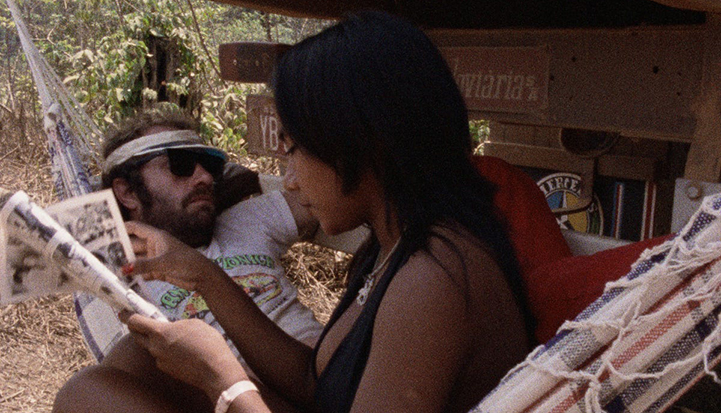
Directors: Jorge Bodanzky and Orlando Senna
Year: 1975
You can tell a lot about a dictatorship by the films they ban.
Without context, it might be hard to understand why the Brazilian military dictatorship banned the now revered Iracema – Uma Transa Amazónica. Finished in 1975, only released at the start of the 80s, it’s the story of an indigenous teenage sex worker on a directionless road trip through Amazonia with a john, a logger profiting from the new highway being cut through the rainforest. I saw it recently at a London screening hosted by Cine Brazil – it’s also included in the BFI‘s Brazil on Film season, showing at the BFI South Bank in June 2026.
Jorge Bodanzky and Orlando Senna’s film is an unusual proposition: half social drama, half documentary. It was the mid-70s, a decade since the coup that handed governance of Brazil to the military and plunged it into authoritarianism. One of their major directives had been to make serious infrastructure forays “to integrate so as not to surrender” the Amazon, building vast roads linking the Amazon to the southeast and the coast, to exploit its natural resources, ship workers into its vast lands, and bring its existing residents under legible control by forcing them out of the forest and into the productive human world.
The 2500 mile Trans-Amazónica Highway, among other giant new roads spearing through the region, was one of the products of this great push westward. Small farms and landholdings began to appear alongside the advancing highways, as opportunists, industrialists and settlers flooded in to commercialise the increasingly naked land, attacking and fighting with the locals along the way. (It bears noting that the architects of these plans, in hungrily describing the terrain, echoed the Zionist clarion call used to colonise Palestine, mischaracterising the Amazon as “a land without people for a people without land”.)
Scratch the surface, and the politics reveal themselves.
(Dig further, and learn that the military regime had already destroyed more than one of Orlando Senna’s previous films while threatening him with prison.)
It’s on this frontier, in the industrial Amazonian city of Belém, that we meet 15-year old Iracema (her name an anagram of America, conceived by 19th century novelist José de Alencar, whose eponymous novel inspired Bodanzky’s naming of the character) and Tião, the cynical, thirty-something trucker and wood trafficker she solicits and catches a ride with. She wants to go in search of a less dreary life than the small-town prostitution that stretches out ahead of her. He wants to haul wood, make money, and get laid as much as possible along the way – and apparently child prostitutes are just his taste.
Tião was played by a seasoned actor, Paulo César Peréio. Iracema was not: the film was Edna de Cássia’s (née Cerejo) first and only role; in the years after the film, she remained in Belém, working as a laundress, a seamstress (a career her character refuses, preferring to roam in search of adventure) and a teacher. Another professional, Conceição Senna – the co-director’s wife – played an older sex worker who takes Iracema under her wing, as the older actress did in real life during filming, at the insistence of de Cássia’s anxious mother.
The film’s title has a double meaning: as well as referring to the highway itself, the word “transa” in Portuguese means a tryst or an affair. In fact, Tião only wants Iracema as a travelling companion for as long as she amuses him; she wants to stay with him and get as far away from home as possible. Amid this tension, he dumps her at an outpost along the road, and here her real troubles begin.
Edna in particular is a revelation. Her Iracema is baby-faced and naive, yet moves through life with wrenching pragmatism and a pugilistic survival instinct. Hers is a confronting, complex and exposing role for a first-time actress, and the directors’ chosen method demanded more of her still. She and her fellow actors only got one reading of the script and improvised their parts, engaging in real, uncomfortable conversations and situations with people along the road, many in dreadful situations, who didn’t realise they were talking to actors.
Filmed over 30 days on the road, Iracema shows a land in flux and turmoil; fire and scorched earth, bald wastes where thick forests once flourished, locals and settlers who describe their misery with candour; and everywhere, everywhere, women and children selling their bodies for survival, and even scrapping over men as their only source of safety and income. It’s not quite the picture of proud, futuristic progress and the “economic miracle” that the regime sold as it ploughed brutally through the rainforest.
The filmmakers’ own road trip was as dramatic and gruelling as the events in the film, encountering searing violence, slavery, death threats and multiple bouts of their own imprisonment by ranchers and soldiers alike. They brought a group of formerly enslaved, recently freed people into the movie, filming their duress in reverse, and built and broke personal bonds with local sex workers everywhere they stopped.
Indeed, while Iracema is a masterpiece, there are questions to be asked about the exploitation of their unwitting cast members, who thought they were being interviewed for a Brazilian TV channel. Some of the sex workers they talked to begged to be rescued from their situations, and were left behind by the travelling crew. While the situations they filmed frequently put them in danger, there’s an undeniable power imbalance between the filmmakers and the people they encountered, forcibly or economically captive in the bleakness of their circumstances. There’s also the tension between the act of playing an indigenous character and the reality of life as an indigenous person in a colonised place; the young Edna, from an indigenous family herself, was apprehensive about mixing with – and being seen as one of – the indigenous people the team encountered, due to the racial persecution they face.
Yet as a dramatic document of the age, the film tells these communities’ stories like never before, and exposes the violent, extractive reality behind the regime’s promises of progress.
“The stories that happened in 1974 still happen today”, Edna de Cássia told journalists fifty years later – and indeed, as films like Manas attest to, issues like child prostitution still loom large in Amazonian communities today, while the Amazon itself has continued to face the ravages of industry and extraction, particularly under the unloving hand of disgraced former president Jair Bolsonaro. “It’s me that aged, not the film.”