Director: Erico Rassi
Year: 2024
Erico Rassi’s proverbial, absurdist modern western is many things all at once. Above all a demonstration of entropy, this strange, soporific film, which picked up four awards and 13 nominations across the Brazilian awards circuit, expels its energy at the start and then ponders what has been lost. Two men stumble out of their trucks to beat the shit out of each other over a woman in the noonday sunshine. So begins this strange, self-replicating tale of men who seek mortal revenge on each other for spiriting their loves away, passively oblivious to the real problems in their lives. Totó (Ângelo Antônio) and Durval (Babu Santana) are at war with each other because Luiza left grey-haired Totó for the younger man. Hitmen of varying abilities are employed, mistakes are made, and off we go on a lonely, aimless sort of roadtrip into the dry, scorched western interior of Brazil.
As stories go, it’s a hall of mirrors. Everywhere you turn, the same story repeats itself: different men, same sequence of events, same failed love, same lyrical motifs, like patterned tiles on a wall. The conversations they have with each other are a dance, observing ritual courtesies and familiar laments but never, ever a sense of how to move forward and resolve one’s troubles – that would break the rhythm of the dance.
It sounds ridiculous and, intentionally, it is. Same Old West positively rustles with dry humour. The characters, who sigh much and smile little, play it absolutely straight. But the turns of phrase, the deadpan delivery, the naïveté and foolishness of the characters, are bleakly funny, and underlines the absurdity of these people and their choices.
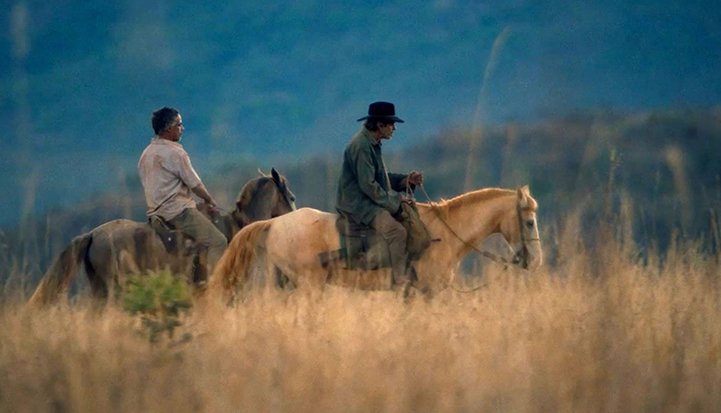
You can’t have a western without a strong sense of place, and Same Old West has it in spades. Set in the remote central-western countryside of Goiás, it boasts some of the most breathtaking landscape photography I’ve seen since Sirāt earlier this year. Richly saturated and almost shimmering with heat, its precision sits in striking opposition to the vagueness of the characters. Rassi wasn’t interested in panning shots or much handheld work. Instead you get perfectly framed, still portraits of the vast, wide landscape. Behind a rusty, arid foreground, blue mountains rise up, nestled between a hot sky and crispy-looking foliage in golden shades of water-starved green. The great stillness of the landscape gazes down, unimpressed, at the idiocy playing out below.
As Totó and his bumbling hired gun, Jerominho (played with slack-jawed mischief by Rodger Rogério), abandon modernity’s trappings and escape on horseback into the backlands, the energy dissipates and the film comes to a near standing stop – fitting enough for characters who’ve lost all forward motion or momentum in their lives. Holed up in a shack with only booze and another broken-down, broken heart for company, they pull us into their stupor – for a while there you really feel you’ll never leave – and it takes a shocking interlude to snap them – and us – out of the daze.
Same Old West is a consummate study in male companionship, loneliness, ego and hopelessness. To the untrained eye, we might be looking at rural poverty, but it goes deeper than that; it’s a lack of care. No sense of pride in their homes or businesses; instead ego propels them away. Crushed beer cans litter the floors, the dishes stay unwashed, a shard of mirror stuck comically to a wall serves as a looking-glass, and the men drink endlessly. To sit down is to drink.
Amid this shambles, women loom large in their absence. The male characters all, in turn, and in the same words, lament their attachment to their lost women (they can’t say the word ‘love’, but they can devise terrible, stupid plans to demonstrate it – or at least their territorial need to call someone ‘theirs’) – in a landscape completely devoid of women. They talk about going into town to bring some little lady home – to keep them company and keep house, to work around their self-imposed incompetence. The initial scapegoat for all this trouble, Luiza, is a but a disappearing figure over the horizon in the opening scene; can you blame her? She has nothing to do with the foolishness that follows, named only in forlorn one-sided phonecalls where Totó wanly hopes, for no reason at all, that she might have changed her mind.
Same Old West takes place in one sunbaked locale but could be true anywhere – especially in an epoch where the sexes are increasingly polarised, where growing numbers of men have been riled up into talking about women with politicised entitlement, weaponising incompetence to avoid their responsibilities, and blaming everyone but themselves for their troubles. This film shows the sad end point of that path – the women have left and the men are left with themselves and their collective neurosis. These men can’t keep a woman (she always leaves them for a younger man) because their lives are a dusty, aimless ritual of meandering, reminiscing, formalised repartée and an endless trickle of drinks – or is that why they drink? Is womankind repelled by their inertia, or is their collapse a reaction to her departure? What broke first, the chicken or the egg?